 +
+ Product Information
Composition
Active ingredient:
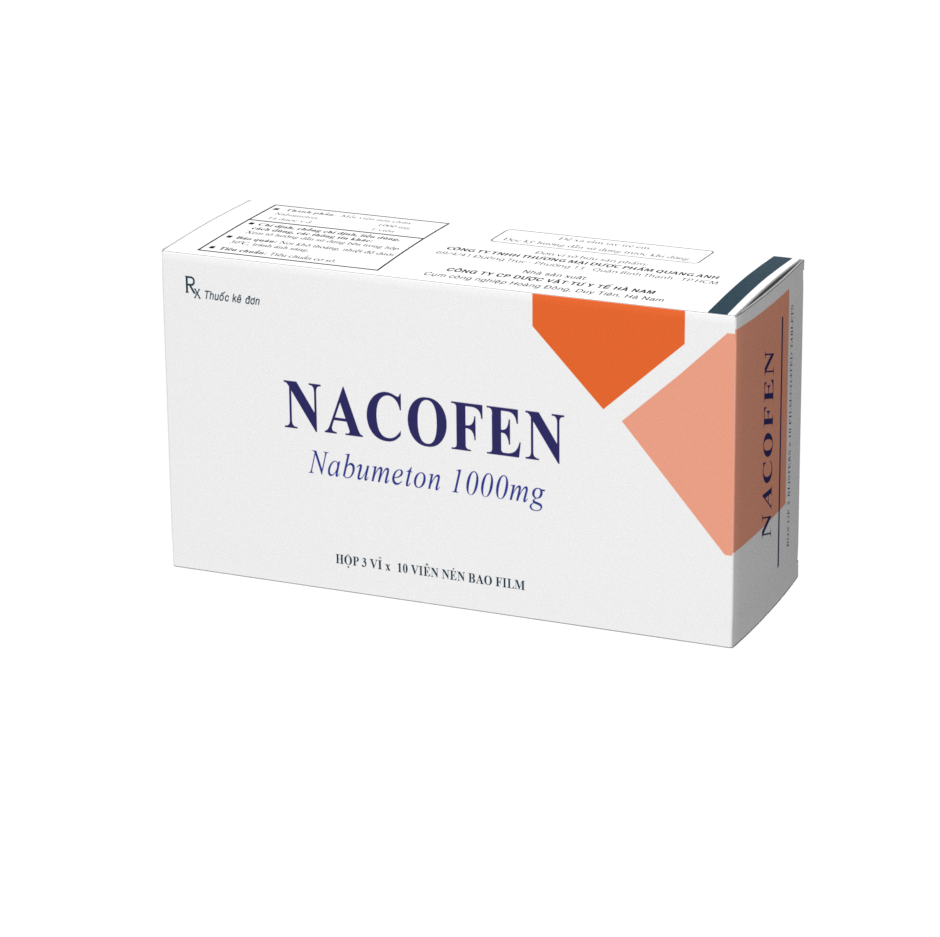
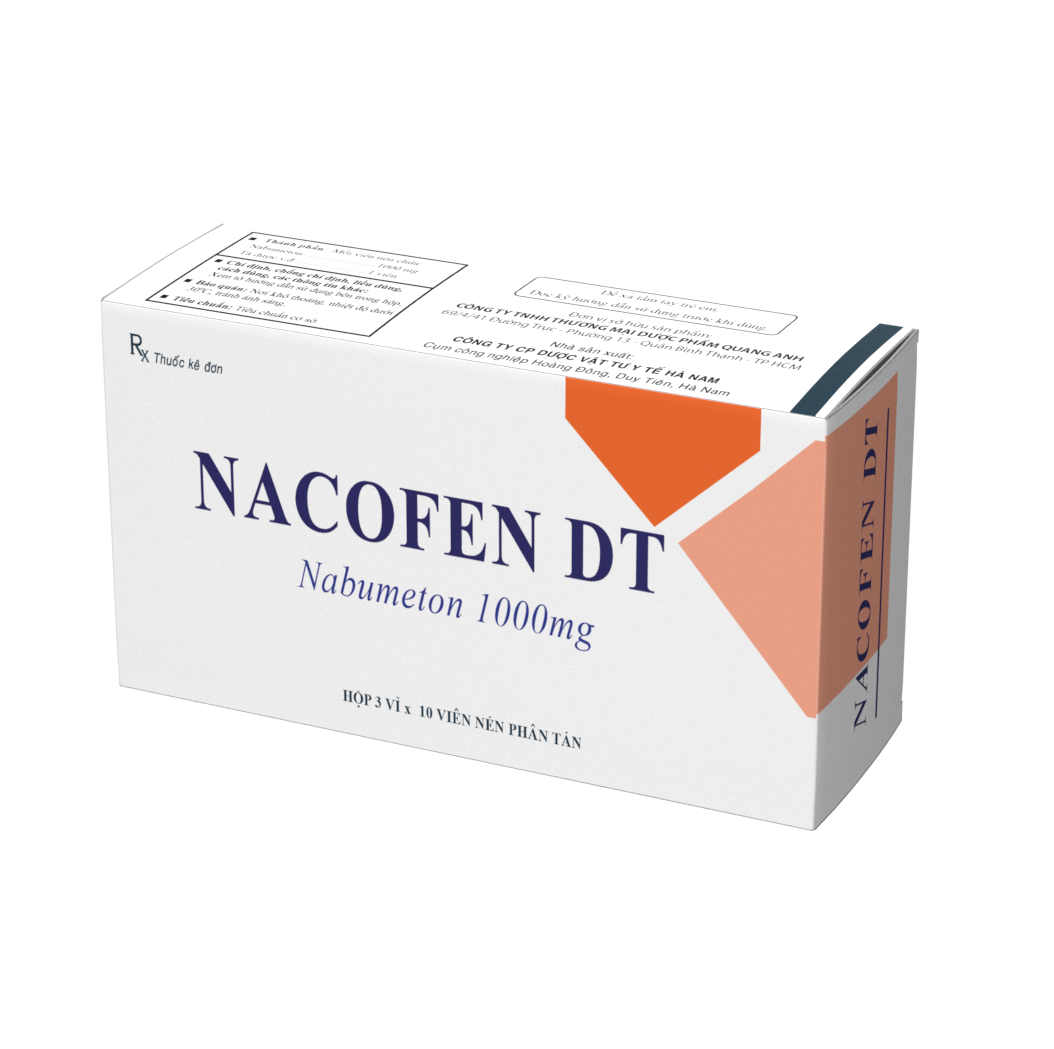
- Nabumetone 1000 mg
Indications
Nacofen DT is indicated for:
- Long-term treatment of symptoms of chronic arthritis, particularly rheumatoid arthritis.
- Degenerative joint diseases and joint pain, especially hip arthritis and knee osteoarthritis.
- Short-term symptomatic treatment of acute osteoarthritis.
Indicated for adults and adolescents over 15 years of age.
Pharmacodynamics
Pharmacotherapeutic group: Non-steroidal anti-inflammatory drugs (NSAIDs)
ATC code: M01AX01
Nabumetone is a non-acidic NSAID belonging to the naphthylalkanone group and a derivative of arylcarboxylic acid.
Pharmacological effects:
- Anti-inflammatory
- Analgesic
- Antipyretic
- Inhibition of platelet aggregation
These effects are associated with the inhibition of prostaglandin synthesis.
Pharmacokinetics
Absorption
Nabumetone is well absorbed after oral administration.
Bioavailability is approximately 80%. After absorption, it undergoes first-pass metabolism in the liver and is rapidly and almost completely converted into 6-methoxy-2-naphthylacetic acid (6-MNA), the active metabolite, reaching peak plasma concentration in about 6 hours.
Absorption is not affected by food, aluminum hydroxide, salicylates, cimetidine, or paracetamol, but may be increased when taken with milk.
Steady-state concentrations of 6-MNA are achieved after repeated dosing (1 g/day).
Plasma steady state is reached within 4–7 days.
Distribution
The half-life of 6-MNA is approximately 20–24 hours and is generally unchanged in elderly patients or those with renal impairment.
6-MNA distributes into synovial fluid, reaching peak levels about 4 hours after plasma peak levels.
It crosses the placenta and is excreted in breast milk in animal studies.
Protein binding is approximately 99%.
Metabolism
Nabumetone is rapidly converted in the liver to 6-MNA, its main active metabolite.
Other metabolites are present in small amounts.
No enzyme induction or inhibition has been observed.
In patients with hepatic impairment, peak plasma levels may be delayed.
Elimination
Metabolites are mainly excreted via urine (80%).
Only about 2% of 6-MNA is excreted unchanged.
Preclinical Safety Data
Toxicity findings are consistent with other NSAIDs, particularly renal and gastrointestinal effects in chronic studies.
No renal damage was observed in monkeys after one year at doses 10 times higher than recommended.
No mutagenic or carcinogenic potential was observed.
Reproductive Toxicity
Animal studies with prostaglandin synthesis inhibitors showed increased risk of miscarriage and embryotoxicity, as well as a higher incidence of congenital malformations, especially cardiovascular defects.
Dosage and Administration
Method of administration
Disperse the tablet in a glass of water before use.
May be taken with or without food.
Dosage
Adults
Use the lowest effective dose for the shortest duration possible.
- Recommended dose: 1–2 tablets per day, in 1–2 divided doses.
- Maximum dose: 2 tablets/day.
Elderly
Do not exceed 1 tablet/day.
Renal impairment
- Contraindicated if creatinine clearance < 30 mL/min.
- If > 30 mL/min: no adjustment required, but start with the lowest dose.
Children
Not recommended for children under 15 years due to insufficient data.
Overdose
Symptoms:
No specific antidote available. Nabumetone and 6-MNA are not dialyzable.
Management:
Gastric lavage, activated charcoal, and symptomatic treatment.
Missed dose
Take as soon as remembered. If close to the next dose, skip the missed dose. Do not double the dose.
Adverse Reactions
Clinical and epidemiological data suggest NSAIDs (especially at high doses and long-term use) may slightly increase the risk of arterial thrombotic events (e.g., myocardial infarction or stroke).
Common adverse effects (mainly gastrointestinal):
- Nausea, vomiting, diarrhea, constipation, dyspepsia, abdominal pain, flatulence
- Gastric ulcer, perforation, or gastrointestinal bleeding (especially in elderly patients)
Adverse reactions by system:
Blood disorders
- Very rare: thrombocytopenia
- Unknown: anemia, leukopenia
Immune system
- Very rare: anaphylactic reactions
Nervous system
- Uncommon: dizziness, headache, somnolence
- Unknown: aseptic meningitis
Psychiatric
- Uncommon: anxiety, insomnia
- Unknown: hallucinations
Eye disorders
- Uncommon: visual disturbances
Ear disorders
- Common: tinnitus, hearing disturbances
Cardiovascular
- Common: hypertension
- Unknown: heart failure
Respiratory
- Uncommon: dyspnea, epistaxis
- Very rare: interstitial pneumonia
Gastrointestinal
- Common: diarrhea, constipation, dyspepsia
- Uncommon: ulcers, bleeding
Hepatobiliary
- Uncommon: elevated liver enzymes
- Very rare: hepatitis, jaundice
Skin
- Common: rash, pruritus
- Rare: Stevens-Johnson syndrome, toxic epidermal necrolysis
Musculoskeletal
- Uncommon: muscle disorders
Renal
- Very rare: renal failure, nephrotic syndrome
General
- Common: edema
- Uncommon: fatigue