
 +
+ Product Information
Composition
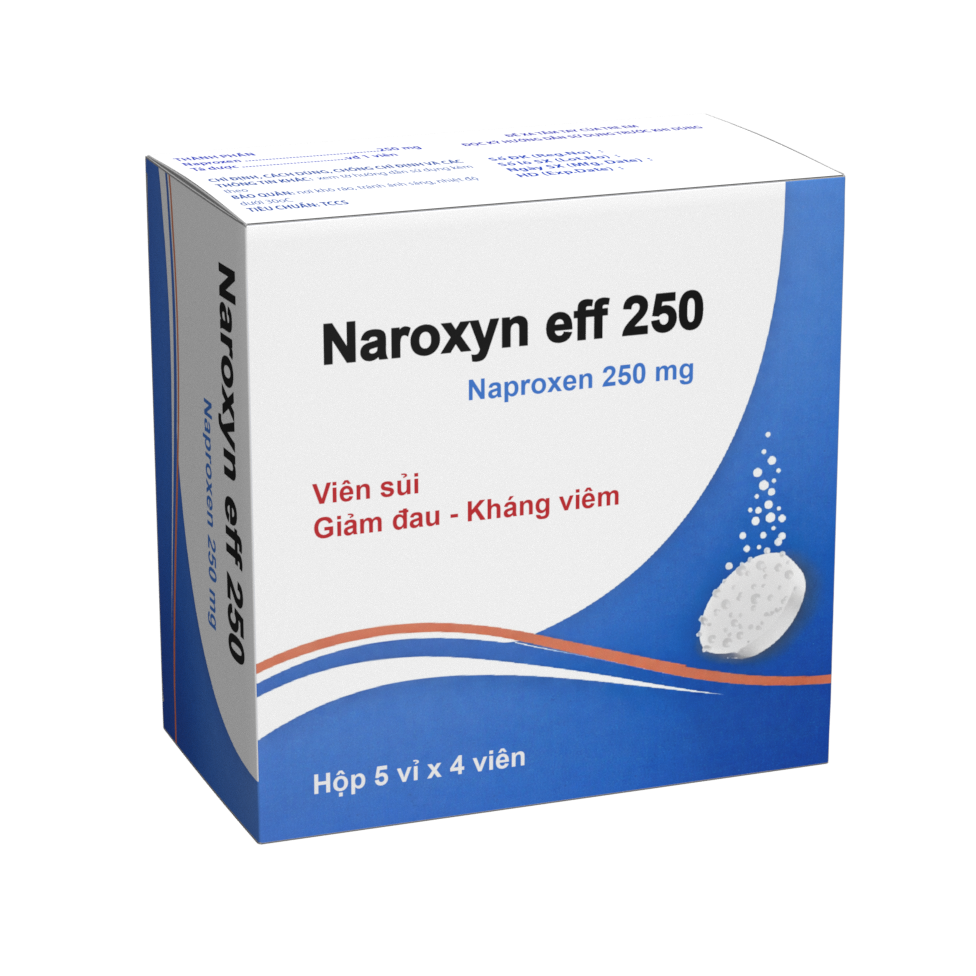
Each Naroxyn Eff 250 mg effervescent tablet contains:
- Naproxen 250 mg
Excipients: q.s.
Dosage form: Effervescent tablet.
Naroxyn Eff 250 mg contains the active ingredient Naproxen in effervescent tablet form, with the following therapeutic effects:
- Treatment of musculoskeletal disorders such as pain, osteoarthritis, ankylosing spondylitis, and rheumatoid arthritis.
- Relief of pain caused by trauma, postoperative conditions, dysmenorrhea, migraine, and soft tissue injuries.
- Treatment of acute gout.
- Reduction of fever.
Dosage and Administration
Dosage
| Population | Dosage |
|---|---|
| Adults | Rheumatoid arthritis, ankylosing spondylitis: Initial dose 250 mg twice daily; may be increased to 500 mg twice daily if prescribed by a physician. |
| Acute gout: Initial dose 750 mg, followed by 250 mg every 8 hours until symptoms subside. | |
| Dysmenorrhea, musculoskeletal pain: Initial dose 500 mg, followed by 250 mg every 6–8 hours. Maximum daily dose: 5 tablets. | |
| Children > 5 years | Juvenile arthritis: 10 mg/kg/day divided into 2 doses, administered every 12 hours. |
| Elderly | Use as directed by a physician. |
| Hepatic/Renal impairment | Dose reduction should be considered. Contraindicated if creatinine clearance < 30 mL/min. |
Administration
Dissolve the effervescent tablet in an adequate amount of water and take with or after meals.
Contraindications
Do not use Naproxen 250 mg in patients with:
- Hypersensitivity to Naproxen, excipients, or other NSAIDs.
- History of gastrointestinal bleeding, ulceration, or perforation related to NSAID therapy.
- Severe heart failure.
- History of asthma, urticaria, or allergic rhinitis induced by NSAIDs.
Undesirable Effects
| System | Symptoms |
|---|---|
| Gastrointestinal | GI bleeding, gastric ulcer, perforation, dyspepsia, colitis, nausea, diarrhea, anorexia, abdominal pain, melena. |
| Cardiovascular | Edema, hypertension, heart failure. |
| Skin | Urticaria, rash, epidermal necrolysis, photosensitivity, Stevens–Johnson syndrome. |
| Renal | Renal failure, glomerulonephritis, interstitial nephritis, nephrotic syndrome. |
| Central nervous system | Insomnia, confusion, difficulty concentrating, headache. |
| Hematologic | Anemia, thrombocytopenia, leukopenia. |
| Others | Hearing impairment, tinnitus, dizziness, visual disturbances, meningitis, pneumonia. |
Drug Interactions
| Drug | Interaction |
|---|---|
| NSAIDs | Increased risk of gastrointestinal adverse effects. |
| Oral anticoagulants | Increased risk of bleeding due to platelet inhibition. |
| Lithium | Increased risk of lithium toxicity due to reduced clearance. |
| Methotrexate | Increased risk of severe toxicity due to elevated methotrexate levels. |
| Antihypertensives, diuretics | May reduce blood pressure control. |
Warnings and Precautions
General precautions
- Avoid concomitant use with other NSAIDs. If necessary, use the lowest effective dose under medical supervision.
- Monitor for gastrointestinal symptoms during treatment.
- Use with caution in patients with hepatic impairment; avoid long-term use.
- Monitor renal function, especially in patients with renal disease.
- Use cautiously in patients with hypertension or history of heart failure.
Use in pregnancy and lactation
Not recommended due to potential risks to the fetus, infant, and mother.
Effects on ability to drive and use machines
No specific data available; caution is advised if adverse effects occur.
Overdose and Management
Symptoms: Nausea, headache, gastrointestinal bleeding, dyspepsia, tinnitus, dizziness.
Management: Symptomatic and supportive treatment depending on severity.
Storage
Store in a dry, clean, well-ventilated place below 30°C. Protect from moisture and sunlight. Effervescent tablets are highly moisture-sensitive.
Pharmacodynamics
Naproxen is a nonsteroidal anti-inflammatory drug (NSAID) that inhibits cyclooxygenase (COX-1 and COX-2), thereby reducing prostaglandin synthesis (particularly PGE2 and PGF2α), which are mediators of inflammation and pain.
Although it inhibits both COX-1 and COX-2 similarly to aspirin, Naproxen shows relatively greater COX-2 inhibition, resulting in fewer gastrointestinal adverse effects compared to aspirin.
This mechanism also explains its effectiveness in dysmenorrhea by reducing uterine contractions and menstrual blood flow.
Pharmacokinetics
- Bioavailability: approximately 95%.
- Peak plasma concentration: achieved within 2–4 hours.
- Naproxen sodium reaches peak levels more rapidly; food may delay absorption but does not reduce overall bioavailability.
- Protein binding: approximately 99% at therapeutic doses.
- Elimination: primarily via urine, largely as unchanged Naproxen.