 +
+ Product Information
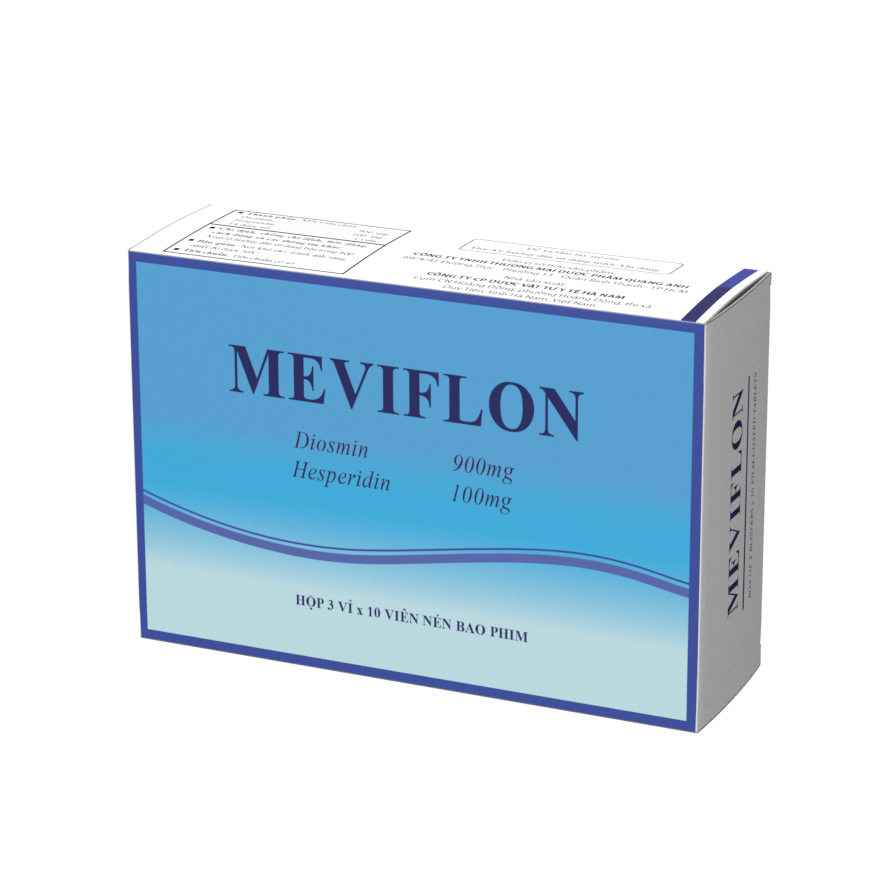
1. COMPOSITION – MEVIFLON
Each coated tablet contains:
Active substances:
- Micronized purified flavonoid fraction equivalent to:
- Diosmin 450 mg
- Flavonoids expressed as hesperidin 50 mg
Excipients:
Gelatin, magnesium stearate, sodium lauryl sulfate, microcrystalline cellulose, sodium starch glycolate, talc, glycerol, macrogol 6000, white beeswax, hypromellose, red iron oxide (E172), titanium dioxide (E171), yellow iron oxide (E172).
2. INDICATIONS
Venotonic (increases venous tone) and vasculoprotective agent (enhances capillary resistance).
Indicated for:
- Treatment of venous circulation disorders (leg swelling, pain, heaviness)
- Treatment of symptoms associated with acute hemorrhoidal attacks
3. DOSAGE AND ADMINISTRATION
Route: Oral use
Administration: To be taken with meals
- Venous insufficiency:
2 tablets daily (one at lunch and one at dinner) - Acute hemorrhoidal attack:
- First 4 days: 6 tablets per day
- Next 3 days: 4 tablets per day
In all cases, strictly follow the physician’s prescription.
Overdose:
No cases of overdose with MEVIFLON 500 mg have been reported.
4. CONTRAINDICATIONS
Hypersensitivity to the active substances or to any of the excipients.
5. UNDESIRABLE EFFECTS
Adverse reactions are classified as follows:
Very common (≥1/10); Common (≥1/100 to <1/10); Uncommon (≥1/1,000 to <1/100); Rare (≥1/10,000 to <1/1,000); Very rare (<1/10,000); Not known (cannot be estimated from available data).
Nervous system disorders:
- Rare: dizziness, headache, malaise
Gastrointestinal disorders:
- Common: diarrhea, dyspepsia, nausea, vomiting
- Uncommon: colitis
- Not known: abdominal pain
Skin and subcutaneous tissue disorders:
- Rare: rash, pruritus, urticaria
- Not known: localized edema of face, lips, eyelids
Exception:
Angioedema (sudden swelling of face, lips, mouth, tongue or throat, possibly causing difficulty breathing).
Patients should report any adverse effects to a physician or pharmacist.
6. WARNINGS AND PRECAUTIONS
Special precautions for use:
- Use in acute hemorrhoidal episodes does not replace specific local treatment.
- If symptoms persist, a proctological examination and reassessment of therapy are recommended.
Pregnancy and lactation:
- Pregnancy: No teratogenic effects or adverse outcomes have been reported in humans.
- Breastfeeding: Not recommended due to lack of data on excretion in breast milk.
- Fertility: No adverse effects observed in animal studies.
Drug interactions:
No interaction studies have been conducted. However, no clinically significant interactions have been reported to date.
7. PHARMACOLOGICAL PROPERTIES
Pharmacokinetics:
After oral administration of carbon-14 labeled diosmin:
- Primarily excreted in feces
- Approximately 14% excreted in urine
- Elimination half-life: ~11 hours
- Extensively metabolized, with phenolic acids detected in urine
Pharmacodynamics:
Pharmacotherapeutic group: vasoprotective agents
ATC code: C05CA53
Mechanism of action:
- Venous system: reduces venous distensibility and stasis
- Microcirculation: normalizes capillary permeability and increases capillary resistance
Clinical pharmacology:
Double-blind controlled studies have demonstrated:
- Significant effects on venous hemodynamics
- Dose-response relationship for venous capacity, distensibility, and emptying time
- Optimal efficacy at a dose of 2 tablets daily
Venotonic activity:
- Reduces venous emptying time
Microcirculatory activity:
- Improves capillary resistance
Clinical trials confirm efficacy in the treatment of chronic venous insufficiency of the lower limbs.
8. ADDITIONAL INFORMATION
Storage:
Store below 30°C.
Shelf life:
4 years from the date of manufacture.